by Jati Lindsay
Julia Keefe grew up on a Native American reservation in Idaho learning songs in two languages: English and the Nez Perce tongue called nimipuutímt. There was the music of powwows, church and other tribal ceremonies, and then a parental record collection of albums by Leonard Cohen, Bonnie Raitt, The Velvet Underground and The Kinks.
But it was the sound of a Swing Era icon more than anything else that first put her on a musical path. “My earliest music memory was listening to Billie Holiday with my mom,” Keefe tells PureHoney, adding with a laugh, “It seeped into four-year-old Julia’s subconscious and took root there.”
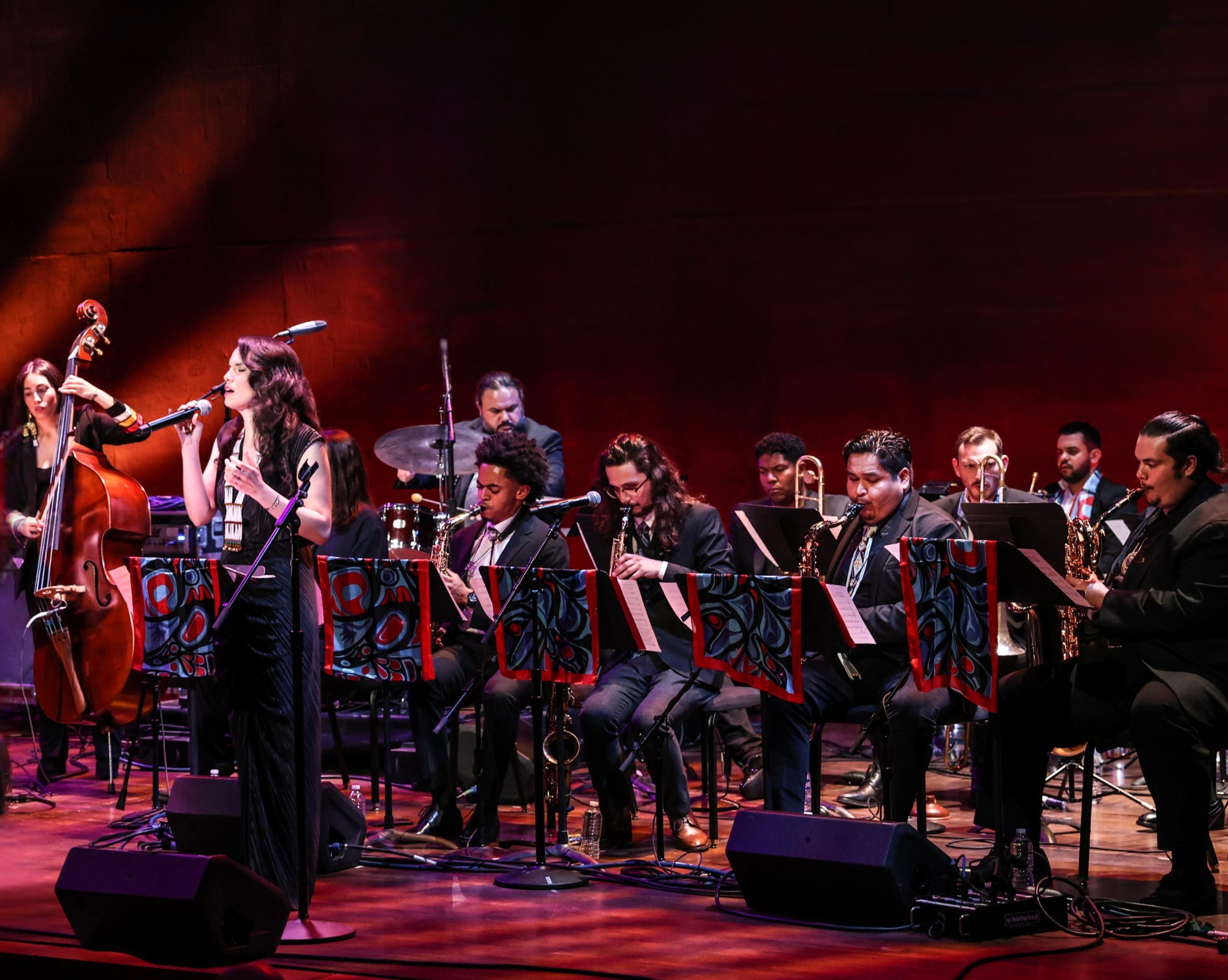
Holiday still lives there but the frontwoman leading the Julia Keefe Indigenous Big Band at the Kravis Center in West Palm Beach on Thursday, October 22, has also come full circle to her polycultural childhood self. Over time the New York City-based singer, composer and bandleader embraced making music drawn from distinct traditions to forge a hybrid of cool jazz and tribal folk with a contemporary, sometimes almost post-classical feel — a kind of modernist swing with an undercurrent of a much older world.
The sense of majesty, mystery and playfulness is audible in Keefe band live performances (available on YouTube) of a 2022 composition, “Blood Quantum,” written by Abenaki of Odanak First Nation citizen Mali Obomsawin. Keefe’s voice rises and falls in an undulating river of trills and classic scat; the 15-piece band scratches, squonks and pivots through episodes of Miles Davis bop and Henri Mancini flair. “Blood Quantum” is a long arc of American history and pre-history in a ten-minute reel.
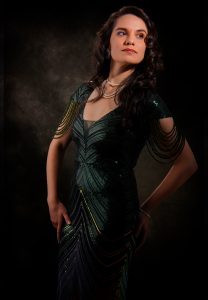
by Kevin Black
Engaging with Keefe’s music opens a window on to both a rich history and a thriving newer subculture of Native American music. The other 14 band members all hail from Native American tribes — Maoli, Muskegon, Comanche, Chippewa, Naragansett, Yaqui, Taino, Olmec, Apache, Lakota, Iroquois and more. The Keefe ensemble’s co-founder is Diné Navajo trumpeter Delbert Anderson.
It wasn’t always this way. Keefe describes a “straight-ahead jazz upbringing” in which she “rarely ventured past the 1960s” in her listening and choice of repertoire. As an undergraduate at the University of Miami’s Frost School of Music it was, she says, ”How do you sing a swing tune from the ’40s and do it effectively in front of a big band, in the correct dialect of this jazz language?” Her discography includes a winsome cover of “Don’t Rain on My Parade,” originally sung by Barbra Streisand in Funny Girl.
Keefe was already well aware by then of another 20th Century jazz singer with indigenous roots: Mildred Bailey, a Coeur d’Alene tribe member and Holiday peer known as a solo artist and featured performer with Benny Goodman and his Orchestra. Bailey became a touchstone for Keefe, someone to model herself on and to champion for greater recognition. (Keefe lobbied Wynton Marsalis for Bailey’s induction into Jazz at Lincoln Center’s hall of fame, a campaign that is ongoing.)
But she was still careful, even — or especially — as a self-identified “Native American vocalist.” People would ask her what that meant, and why then wasn’t she performing identifiably Native American music? “And at that point in my development I just didn’t feel I was ready for it without it being cultural cosplay,” Keefe says. “I didn’t know what that marriage of those identities would look like sonically.”
Another Native American jazz artist helped her take the next step. Keefe heard Pepper’s Powwow by Kaw-Muscogee saxophonist Jim Pepper. “Here was this unapologetic fusion of jazz, rock and Native sounds,” she recalls of a 1971 album that opens with a peyote chant and war whoops. “And it doesn’t feel forced; it feels so authentic and organic.”
Keefe carried that knowledge with her to New York’s Manhattan School of Music. “It was when I started shifting the sonic focus, in grad school, towards indigenous melodies as part of the jazz language,” she says. Melodies taught to her years earlier by “a lot of my aunties and uncles” became a basis for her classes in composition — but not before she asked her relatives for permission and realized she had to steer clear of some of her picks, she says.
“A lot of times they’re prayer songs, and you want to make sure that you are following cultural protocols,” Keefe says. “And if it is a prayer song, this is sacred and you can’t use this. And that’s the end of the discussion.”
The Keefe Indigenous Big Band’s 2026 debut album, Incarnadine, lives in both universes: It opens with “Water,” a classic ensemble instrumental you can imagine hearing over drinks at New York’s Birdland nightclub. It also contains the solemn harmonizing of “Wawasint8da” and a three-movement suite ending with percussive “Iron Horse Gallup.”
Keefe’s live set traces a similar journey. “Contemporary jazz with ancient indigenous melodies — it will challenge some folks and push the envelope for some folks,” she says. “But we’ve found is that because we sort of start where people are comfortably … and we just kind of guide through storytelling and songs into the more challenging material, people really appreciate the way that story itself unfolds.”
Julia Keefe Indigenous Big Band performs October 22, 7:30pm at the Kravis Center Helen K. Persson Hall in West Palm Beach. juliakeefe.com GET TICKETS! ~ Sean Piccoli