 Few artists have struck the balance between fine art and commercial appeal as perfectly as Alphonse Mucha. A leading figure more than a century ago in the Art Nouveau movement — whose swooping lines and botanical motifs were a hallmark of Europe’s golden Belle Époque, before World War I — Mucha endowed popular art with a visual language that is beautiful to look at and culturally relevant today.
Mucha took photographs, made posters, illustrated books, and created jewelry, stage sets and costume designs, employing various techniques across different media to produce a body of work with a lasting impact on art and illustration.
A traveling exhibition, Timeless Mucha: The Magic of Line, currently on display at the Boca Raton Museum of Art, surveys the Czech-born artist’s career through more than 100 works on loan from Prague’s Mucha Trust Collection. Timeless Mucha explores his process and the evolution of his distinctive style — from his signature “Q formula” compositions that revolutionized graphic arts to a fusion of vibrant colors and otherworldly elements that would later find its way into psychedelic art and Japanese manga.
“Mucha didn’t invent Art Nouveau, but he is its father,” Boca Raton Museum of Art Curator Kelli Bodle tells PureHoney. “He expanded it, deepened it and fully explored its possibilities.”
Mucha’s breakthrough came in Paris in 1894 with a commission for a poster promoting the French stage actress Sarah Bernhardt in the world premiere of the play Gismonda. The artwork became a sensation and spurred a long-running partnership: she as his muse, and he as the artist who could capture the mystique and magnetic stage presence of “Divine Sarah,” as Bernhardt was known. People today barely remember the play, but they know the poster of Bernhardt as the title character wreathed in runic lettering and a floral crown.
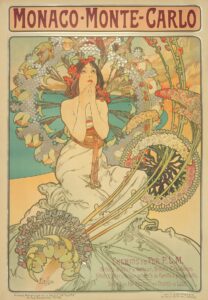
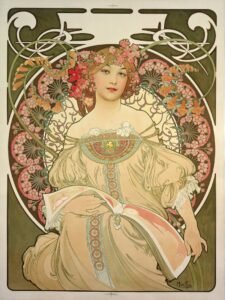
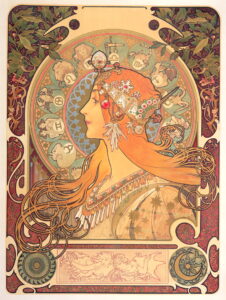
Mucha’s posters blended lush designs with flowing natural forms, often featuring a nymph-like woman as the central figure, framed by a decorative border, splashes of flowers and a prominent circular outline that evokes a halo. Placing his subject asymmetrically in an arc or a circle was the basis of his Q formula. The women were undeniably feminine — dreamy eyes, cascading hair, cheeks suffused with color, symbols of sensuality and self-possession. The popularity of his illustrations proved that art could be both aesthetically pleasing and widely accessible.
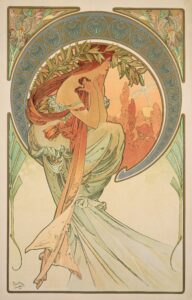
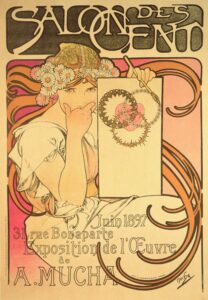
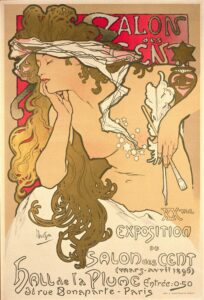
“Posters during that time were seen as disposable,” Bodle says. “But once Mucha began making them extraordinarily beautiful, people would go out at night with razors to cut them off the walls and bring them home. Imagine doing that today — seeing a poster on a telephone pole and thinking, ‘This is the best artwork I’ve ever seen,’ and then taking it home. That’s what he achieved.”
Alongside some of Mucha’s most recognizable lithographs — including Job, Zodiac and Rêverie — Timeless Mucha presents objects, sketches and photographs that reveal how he developed and refined his technique. Photography, in particular, shaped his understanding of anatomy and movement, while the Japanese woodblock prints he collected early in his career inspired his use of bold lines and floral patterns.
“What’s exciting is that later generations of Japanese artists, especially in manga, were looking back at Mucha and using his style as their inspiration,” Bodle says. “So it makes this lovely circle, where you can trace other cultures’ interpretations of Mucha directly back to his art.”
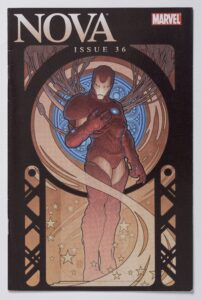
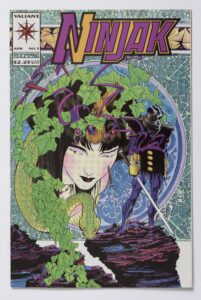
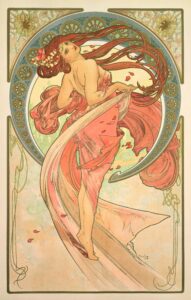
The exhibit also explores Art Nouveau’s revival during the countercultural movement of the 1960s and ’70s. It’s not difficult to see how some of the most famous psychedelic rock posters and LP covers for bands like the Grateful Dead and Diana Ross & the Supremes harken back to Mucha. His influence is also evident in video game art and in covers for Marvel Comics, with their distinct geometrical shapes, curvy lines and foregrounded main characters.
The show sheds light on the inimitable style that made Mucha timeless: a compelling harmony of classical and modern art. His work transcended time and cultures, conveying a moral and spiritual depth that spoke to wide audiences. He believed art should be enjoyed by everyone; that, as much as his singular skill, defines his legacy.
Timeless Mucha: The Magic of Line is on view until March 01, 2026, at the Boca Raton Museum of Art. bocamuseum.org ~ Trina Gray
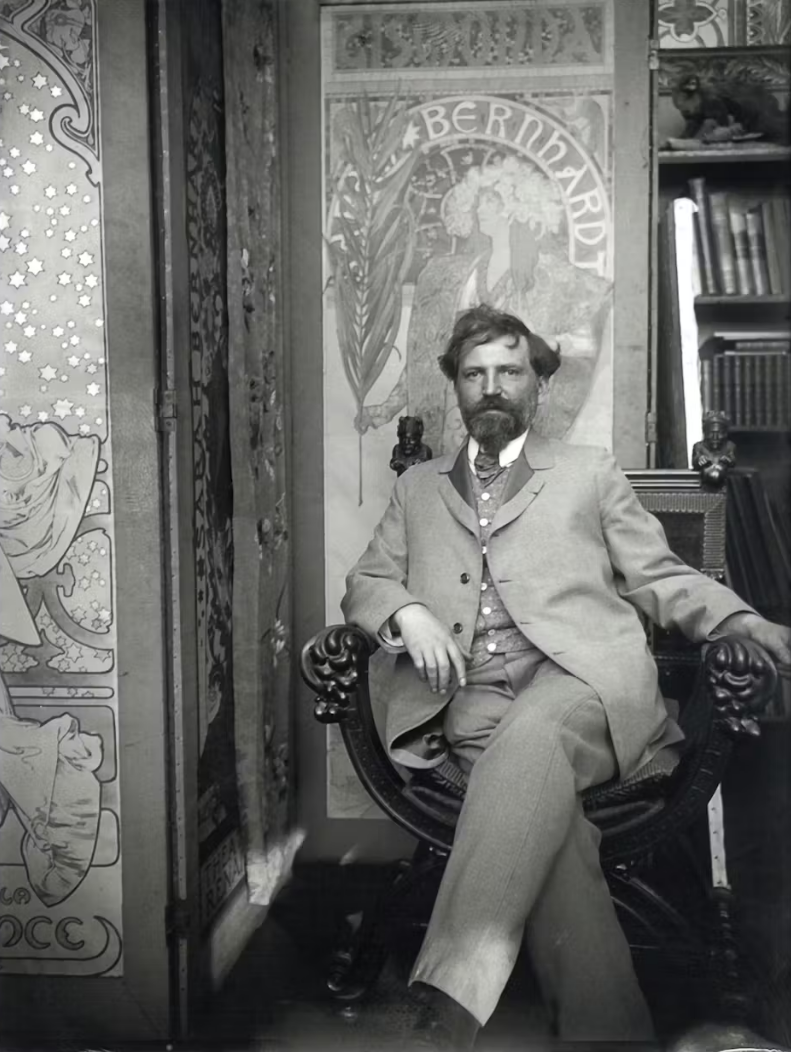
Self-portrait for Sarah Bernhardt c1901 © Mucha Trust 2024