by Jay Spencer
When a band call themselves Devo, as in short for “de-evolution,” it helps to go back to their beginnings to look for truth in advertising. Just how devolved, really, are Devo? Without a time machine it’s tough to see the new wave band’s reported origins in Akron, Ohio in 1973 as a kind of anti-art adventure. But a listen to their first LP, 1978’s Q: Are We Not Men? A: We Are Devo!, is revealing.
The opener, “Uncontrollable Urge,” is all spastic, kinetic energy that leaves a listener defenseless against the impulse to shake, rattle and roll, and it belongs on the short list for greatest opening songs on a debut album. So in a sense, after starting with perfection, there was nowhere for this band to go but down, ergo devolve.
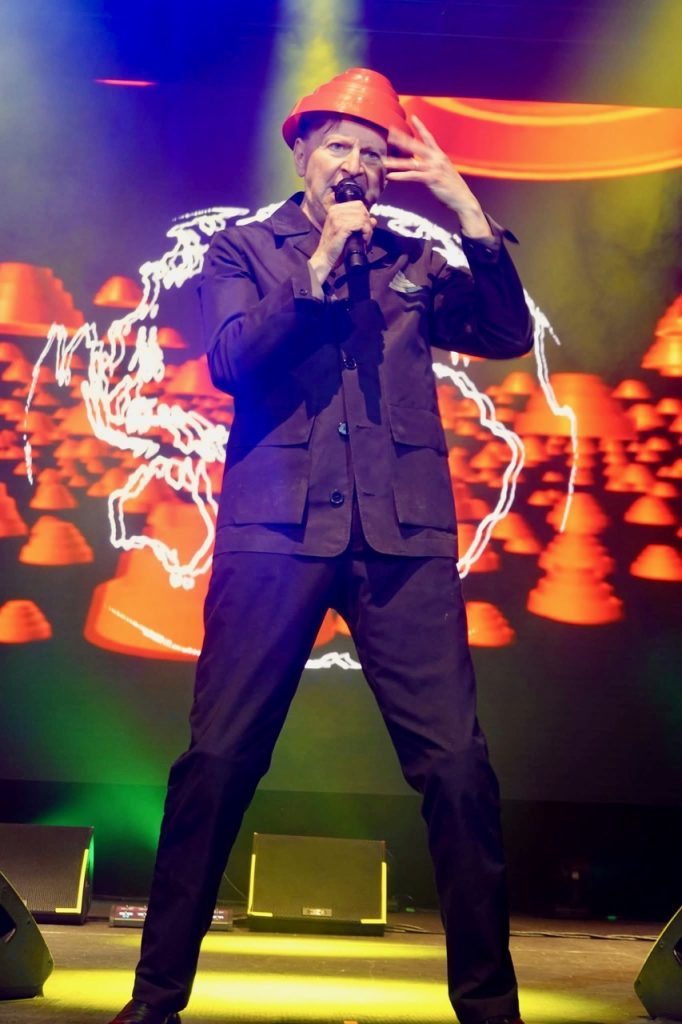
Gerald V Casale
Yet the second track is a different kind of de-evolution: a cover of “(I Can’t Get No) Satisfaction.” Where the canonical 1965 Rolling Stones song radiates so much cool and lust for kicks that we take it for granted, Devo decided to play it sounding like foreign exchange students from another solar system. Through their dry line readings you can almost believe they had not heard “Satisfaction” a thousand times like everyone else before they tried it. (Legend has it that Mick Jagger, upon first listen, was ecstatic.)
Other Q&A songs arrived with titles that could get a band cancelled in the, if not de-evolved, then definitely more sensitive 21st Century. First single “Mongoloid” is lo-fi, post-punk sociology that won praise from rock heavyweights David Bowie and Neil Young. The b-side, “Jocko Homo,” is as otherworldly as the title would make you hope or fear, and is featured in Devo’s own short film, In The Beginning Was the End: The Truth About De-Evolution. The album’s de-facto opus, Gut Feeling (Slap Your Mammy), builds from a twangy motif with ticklish keyboards to a yowling vocal aimed at a soon-to-be ex, and finishes with a demented, double-time coda — a breakup song with heart and bile.
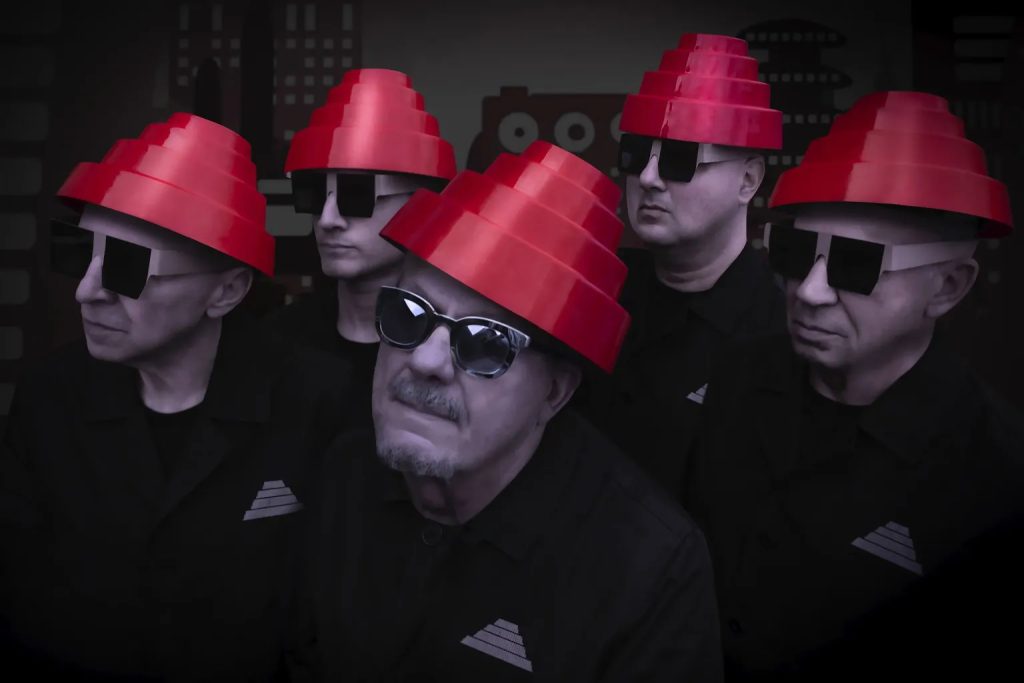
Whether you consider rock stardom evolution or regression, it was the quintet’s third LP, 1980’s Freedom of Choice, that really threatened to make Devo a household name and/or product. The flagship song, “Whip It,” was the first and only Devo single to crack the US Top 40. As for the video, art-minded Devo had always experimented with a distinctive visual look, but the dawn of MTV allowed image to be everything, and Devo blew up this mandate to novelty-song proportions. All dressed in black, except for their trademark red flowerpot hats, on a dinky old west homestead, the band perform their catchiest hook with total commitment to the song’s blatant double entendres, and to being comically out of place on the little prairie. Rewatching the video almost 50 years later, the subversiveness and sense of humor endure. It also feels like a big influence on the 1984 comedy classic Revenge of the Nerds.
“Whip It” ended up being Devo’s evolutionary or de-evolutionary mainstream peak. Through the 1980’s and beyond they continued to stay relevant on the edges of popular culture. The Simpsons and Family Guy both parodied “Whip It.” Devo’s unique cover of Lee Dorsey’s “Working in the Coal Mine” charted after being in the closing credits of the 1981 animated movie, Heavy Metal. If there was a low point, it was ”Theme from Doctor Detroit.” The title song from the 1983 Dan Aykroyd comedy felt stale and, for the first time for Devo, predictable, as though they were trying to commodify their oddball sound.
But there was no need. The magic formula was right there from the beginning: Wound-up songs, straight from the id, warbled oddly and performed with a twitchy choreography, like some adolescent robot stuck between its programming and its feelings. Local fans will have a chance to relive uncontrollable urges and see what is, remarkably, the first South Florida Devo concert of the 21st century, their last being 1988 at The Button South in Hallandale Beach. The current touring incarnation features original members Gerald Casale, Mark Mothersbaugh and Bob Mothersbaugh, and set lists from recent summer shows in Europe promise faithful renditions of many songs discussed here.
FULL INTERVIEW TRANSCRIPT BELOW!
Devo perform 8pm Friday, August 28 at The Fillmore Miami Beach. clubdevo.com ~ David Rolland
PureHoney interview with Devo’s Gerald Casale by David Rolland
PureHoney: When did you first fall in love with music?
Casale: Oh, my God. I think it’s when I was four or five. My parents told me that I used to grab on to the huge floor-based console that people all had back then that were radios. They were heavy and bulky in a piece of furniture, and they would tune in to these stations that were playing things like Tex Ritter and Ghost Riders in the Sky. You know, it was Ohio, and it was a lot of country and hillbilly. But it’s where I first heard that music and I would grab onto the floor-based unit, and danced to it. Like, jump up and down, and jerk to it. Soon after that I heard Elvis Presley.
Did you pick up instruments soon after that? Did you start making your own music?
Casale: No, no, no, you know, I wanted to. I imagined myself drumming. At one point, I thought I was going to play a trumpet, I don’t know why. But, you know, in each case, my parents were very blue-collar and they were Catholics, so they had too many children. They couldn’t afford to give me any lessons, or buy me any instruments, so it never happened. Nothing ever happened until I started listening to Bob Dylan, his early, acoustic stuff, like Another Side of Bob Dylan, and I made enough money, you know, menial jobs as a minor, as a minor teenager, where I bought myself an acoustic guitar. So I was probably 12 or 13, and started trying to, you know, just listen to records and pick out the bass lines and the chords. I bought a book that showed me chords, you know, self-taught.
This morning before we talked I watched the Devo documentary on Netflix. They show a lot about your philosophy, the band’s philosophy, but not so much the music. Musically how did you guys envision Devo when you formed?
Casale: I’d learned to play well enough to be in this locally famous blues band in northeastern Ohio called 15, 60, 75, The Numbers Band. They still exist today. They’re legendary, you know, and they’re legends in their own minds. They’re so famous around there, and so revered, and so respected, because the lead singer, Bob Kidney, was basically a musicologist, a student of the blues. He had the most incredible library of rural and urban blues, you know, acoustic and electric, whole history, VJ recordings, you know, all those early labels that reprinted stuff that were even on those wire recorders. Anyway, he taught me so much about the blues, right? He taught me how to play harmonica. And so that’s what I was doing. Of course I liked all the British invasion that were basically taking American roots music, blues, and R&B, and twisting it up, and reinventing it. And I loved that, and it was all blues-based.
Mark, on the other hand, he was a little younger than me, and he had somehow been basked in prog rock. So he was the guy that got music lessons and learned to play the piano when he was 5 or 6, and so he was all about, how many notes can I play in 5 seconds, you know? And how many time signatures can I switch to?
And I wasn’t really into that, and he was really not into blues-based music. So we were both visual artists, so we said, okay let’s do what we do visually in music, which means we’ll start with Tabla Rosa. We won’t base anything that we do on music that you’ve already heard, that’s already on the radio, that’s already popular. We’re going to start over, and if it sounds like something else throw it out. Not cool.
And that was the mantra. So, it became this, um, self-imposed minimalism. Conceptual minimalism. And we would actually say, well, why are you changing after 8 bars? There’s no reason to change after 8 bars. You’re just doing that because songs change after 8 bars. And we would laugh and just say, okay, no, unless you can explain to me why we’re changing, we’re not going to change.
It took a long time for you to make a living off of your music. What was the key in being able to stay together? How was it you were able to keep going?
Casale: Probably because in the environment we were in in northeastern Ohio, nobody even gave a fuck right? It’s like the few people that paid attention to us either felt sorry for us or hated us. And we believed in what we were doing. But nobody was coming around and publicizing this stuff, so we kept doing it because we loved it and believed in it, and then we got better at it, and we kept writing songs, and keep getting better at it, and finally, you know you get your head above the water, right? You see the light of day, you play in these clubs, and there’s a core group of people that think you’re great, and other people are wanting to punch you out. And the more people that hated us locally, then the more we were, you know, inspired, because the kind of people that hated us, we hated them too. So, it was like, okay, we must be doing something right if they don’t like it.
Was it strange when you did become famous, when you had David Bowie and John Lennon knowing who you guys are?
Casale: maybe I’m the only one that would ever say this, but not to me. In other words I thought I knew this 4 years ago. Thank you. Thank you for the vindication, right? In other words, when the people that you revere and love and inspired you come forward and reciprocate, it is really what’s the word? Heartwarming, to say the least. Was I surprised? No, that’s what I wanted, and in fact, that’s what I expected.
I enjoyed your new song. It seemed to go along with what your image of Devo originally was. Do you want to tell me a little bit about “Just Do It”?
Casale: The way I did in 1980. I still feel the Devo spirit. You know, my art was born of protest and trauma. I’ve often said in interviews that I don’t think that I would have gone the direction I did, given what I was doing prior, if the killings at Kent State University in 1970 hadn’t happened, and I was politically active. I was in SDS. We were protesting the expansion of the Vietnam War into Cambodia without an act of Congress. Sounds familiar, doesn’t it?
Nixon was an authoritarian president. He was defying the, uh, rails of the three divisions of government, you know executive and judicial and legislative. And at that time, a large swath of the American public, and especially young students were very aware of the danger, the threat to the Constitution that this represented. And so those protests that day were national. They were on hundreds of campuses, and across America, people couldn’t believe we were bombing Cambodia now, in addition to the atrocities of Vietnam, and that he just did it on his own, and Congress had nothing to say about it.
And, uh, did we know that the National Guard that the governor sicced on us, the governor of Ohio. Did we know that they had live ammunition in those guns? Absolutely not. Nobody thought so. It had never happened in history, and so, when they started chasing us with tear gas, trying to herd us into an area where they could put us on buses and send us to jail.
When they stopped and made a formation, we were all in wonderment, like, what’s going on here? You know, confusion. Next thing we know, they shot! Straight into the crowd, like a duck shoot, right?
How close were you to the people that got shot?
Casale: Well, you know what’s funny? All the people that got shot, wounded, or died were behind the group of people I was in. They were further away from the Guard. And you got to remember, the Guard was within one or two years of us. Like, they were all basically kids like us. They had joined the National Guard, some of them just to stay out of Nam, right? I know they could see us, right? I know they could identify us. I wasn’t so far away, maybe… I don’t know, 75 feet, maybe, maximum. They could see everybody’s faces, but they had gas masks on, right? Because they were shooting tear gas. So my theory is that when they were given the order to shoot.
They couldn’t bring themselves to just point blank shoot people right in front of them where they knew they killed you, right? They shot high because they were at the top of the hill, we were at the bottom of the hill. So they shot over our heads. Two of the four students who got killed were friends of mine, Jeffrey Miller and Allison Krause. Jeffrey was about 25 feet behind me on a pathway to the gymnasium when he got shot, and Allison Krauss was even further in the student-teacher parking lot. And it went in her back, right? She got shot in the back. It was hideous! It was life-changing, traumatizing, horrid.
I’m sorry you went through that. Do you see a lot of similarities between then and now? Trump, Nixon, do you see them as the same?
Casale: Whatever forces were at work around 1970 with a dictatorial president and the collapsing of the three guardrails of government, that today it’s on steroids. Like, it makes that look, back then, like kindergarten. You got to remember, in the end, it all worked. Even a Republican Congress rebuked him. They impeached him, because they actually enforce the rule of law.
And we’re so far beyond that now. That’s what I’m appalled at. That’s what I’m freaked at. That’s why I put out the song. What does everybody think is going on here? They still go, oh, uh, there’s some threats to democracy here. It’s like, folks democracy left the building. There is no exaggeration here historians and pundits liken what’s going on now to the demise of the Weimar Republic with a fascist playbook. There has been a coup. The rule of law is done. Democracy is bye-bye. What we have now is a dictatorial tyrant empowered by the Supreme Court. And election-denying governors and so on, across the board with billionaires backing him because they are anti-democratic, too, because they don’t like regulation. They don’t like taxes. So they don’t care what he’s doing to the First Amendment or women’s ability for healthcare and, you know, reproductive rights. They don’t give a shit about any of that. They’re just happy that they get to keep more of their money.
And it’s that simple, and it’s over! The coup happened. We are now living in a third world dictatorship. And you can see freedom of the press is being attacked like front and center in the broad light of day, like in your face, in the broad light of day, over and over. Independent institutions, education, higher education.
And they are caving, and they are running scared. And the corporate media is just reporting all this as if it’s normal. Because they’re owned by the billionaires who were benefiting that’s where we’re at.
Have you found any younger artists who have the spirit of Devo in protesting this?
Casale: You know, there probably are, and I may not be the guy in a position to be keeping up, but I need to be told, hey, Jerry, look at this. You know, um, I’m sure there have to be, because I know that there’s hundreds of thousands of millennials who hate what’s going on. And they’re victimized by what’s going on, and they’ve never even tasted freedom like I did before it went away. They grew up with 9-11, COVID, and getting reamed, where they have to do a gig economy to even have a crappy apartment.
You know, it wasn’t like that then. I was able to go to college from a blue-collar family, because I got a crummy little scholarship, and then I worked in the summer to pay my way through school, because it didn’t cost $50,000.
This is the first time Devo has played South Florida since 1988. What’s kept you away from us for so long?
Casale: Nothing kept us away except lack of demand. I mean, you just look at, you know, we talk now about red states and blue states, and there’s this national crisis and being more divided than ever. Since basically 1968, this country has been as divided as it is now. It’s just more in your face. And Florida has become a flaming red state, and there was never any demand. There were no promoters going, hey, Devo, come down here! And we’d go, no! You know, it wasn’t like that. It was no interest. Zero.
A lot of people weren’t even born the last time you came here, so tell us, what can we expect at a Devo show?
Casale: Wow. Well, you know, I don’t think we would be out there unless we felt we could still deliver, because Devo was never boring. Devo was never about just playing your songs, and you might as well shut your eyes and think you’re listening to a record. It’s theatrics, and visuals, and energy. And I think what you’re going to see is something that you’re going to be entertained by and excited by, because we now have three generations of people watching us. I’ve joked that we’re the new Grateful Dead, because we go out there, and there’s people from our generation that are still alive, that are there, that were fans from the beginning, and then there’s their children, and then there’s their children, and those kids are the most flipped out, because they discovered us on, like, you know, YouTube and Vimeo, and they know all the lyrics, and they’ve never seen anything like Devo, because music changed so much. Nobody does what Devo does. Nobody sounds like what Devo sounds like. Nobody talks about in the lyrics what Devo talks about, so they’re just like amazed and really entertained. It’s fantastic.
How would you say as a live act have you guys evolved or devolved over the 50 years as a live band?
Casale: Evolve-wise, we actually play better than we used to, because we know more how to manage yourself on stage in a rational way to really deliver, rather than being so involved in the moment. Maybe we don’t play as fast, because when I watch the old concert footage of Devo I’m blown away by how insanely fast the BPMs are, but we’re playing tight! And I’m like, wow, we actually were good.
Is there any hope of new Devo music?
Casale: You know, I wish so much. Believe me, I wish I wasn’t the only one carrying the torch. I wish, rather than my solo album, that it was a Devo album, because I go to radio stations, or I go to SiriusXM, and they interview me, and they go, wow, you know, this new song, if this was a Devo song, I’d be playing the shit out of it.
It’s like they don’t realize what an insult it is. It’s like, here’s the guy that collaborated and wrote with Mark 85% of Devo songs, right? And in addition to directing videos and designing the stage shows. And no wonder it sounds like Devo. I’m fucking Devo. It’s a joke, so what I like to do is maybe do a humble little opening act solo thing that I could go out in front of a big act right now, like, right? Go out. I don’t know, open for the Foo Fighters, I don’t know. With my solo stuff, and maybe throw in a couple Devo things.
Devo had this 1980s nerd aesthetic, visual aesthetic that you guys seem to have created and then I saw you worked on Revenge of the Nerds. How did this nerd aesthetic come to be?
Casale: I think just because of what we were doing and the originality of it. All the disenfranchised kids that don’t feel part of mainstream society glommed onto Devo. And so Devo became a kind of a beacon where these kids could feel like they weren’t alone, and they weren’t isolated, and that there was somebody out there speaking out for them through art. And so they adopted Devo, and so it was there. You know, we didn’t… I didn’t, like, do it on purpose in a cynical way, but it became obvious who is embracing Devo.
Anything we didn’t go over that you’d like to talk about to your Miami fans?
Casale: No, I mean, other than just reiterating how appalled I am at what is going on in America. I am just overwhelmed and in disbelief that this horrible person. Forget Democrats and Republicans and all that. This isn’t about that. This is about a vile man with no ethics. A grifter, a criminal, a tyrant destroying people’s lives. In other words, exacerbating inequality, taking the taxpayer’s money and putting it in his coffers destroying international relationships, First Amendment rights, higher education, scientific research. This is a joke.
This makes Idiocracy, the film, look like a sweet little lullaby, compared to Macho Camacho being president. This is a horror show.
What would you say people should be doing if you had your way?
Casale: Oh, my God, there should be massive, massive protests, you know? Like there were in, what was it, Albania against Ivanka Trump trekking over that island or whatever. Where the people for two weeks, like there were 500,000 people out there saying this is bullshit. There should be more than that going on now, because your freedoms are being destroyed.
Is there any political discussion at your shows, or do you just hope people get the message through the lyrics?
Casale: I do what I can. I do what I can. Devo was never really about being on the nose politically or, you know, supporting one candidate or one party, because what we saw is the flaw, the duality in human nature. So there are bad actors on any side of the political spectrum, right, at any given time. And they are all guilty, but we just have one particular guilty guy right now, and I don’t think that it really has much to do with the fact that he’s a Republican. It’s beyond that. It’s just a super bad guy.